
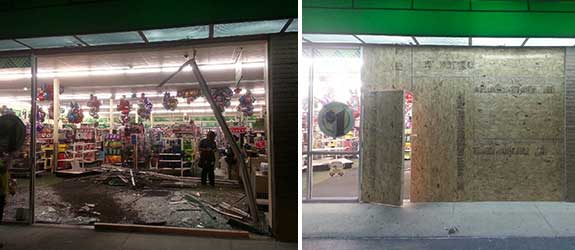
A break-in, severe storm, fire, or other sudden property damage can leave a home or business exposed within minutes. For Chicago property owners, a broken door, shattered storefront window, or damaged entry point can create immediate concerns involving security, weather exposure, and additional damage.
The first priority is personal safety. If a break-in may still be in progress or there is an immediate threat, stay away from the property and call 911. Once police, firefighters, or other appropriate authorities have cleared the property, emergency board-up service can temporarily secure damaged doors, windows, and other openings until permanent repairs can be completed.
What local property owners should know
-
Do not enter a property if you believe an intruder may still be inside or the structure may be unsafe.
-
Preserve the scene until the Chicago Police Department or other responding authorities indicate that you can proceed.
-
Broken windows and doors can expose properties to rain, wind, debris, unauthorized entry, and additional damage.
-
Severe weather across Cook County can also create sudden openings that require temporary protection.
-
Photograph visible damage when it is safe to do so, and keep records related to emergency work and later repairs.
Why Emergency Board-Up Matters After Property Damage
Emergency board-up matters because it provides temporary protection when a door, window, storefront, or other exterior opening can no longer secure the property. In Chicago, promptly covering an exposed opening can help limit unauthorized access and reduce exposure to rain, wind, debris, and additional physical damage while the owner arranges permanent repairs.
This is especially relevant across a city with a mix of brick two-flats, three-flats, single-family homes, apartment buildings, warehouses, restaurants, and street-level storefronts. A broken opening in a Logan Square residence creates different practical challenges than damaged glass along a busy commercial corridor, but both can require fast temporary security.
Top Board UP provides board-up services for local properties dealing with these situations. After this first introduction, we will use we, our, and us when discussing the service process.
Local Data and Conditions Property Owners Should Consider
Recent National Weather Service reporting shows why emergency property protection is not limited to burglary or vandalism. In July 2026, severe storms in the greater Chicago metropolitan area produced tornadoes, destructive straight-line winds, damaging hail, flooding, and structural damage, including significant impacts in southern Cook County.
The National Weather Service Chicago office reported that portions of southern Cook and eastern Will counties experienced winds estimated at 80 to more than 100 mph during the July 27 event. Conditions like these can damage windows, doors, roofs, siding, and surrounding trees.
The City of Chicago also requires buildings to be maintained in safe condition, including windows and doors. Requirements become more involved when a property becomes vacant or dangerous, so owners facing extensive damage should determine which municipal requirements apply to their specific building rather than assuming temporary boarding is a permanent solution.
How an Unsecured Opening Can Affect Your Property
An unsecured opening can turn one incident into several property problems by leaving the interior accessible and exposed. A shattered window after a break-in, for example, may begin as a security problem but can become a water-intrusion or interior-damage problem if bad weather arrives before permanent glass replacement.
This matters for homes in neighborhoods such as Lincoln Park and Wicker Park, as well as commercial buildings on busy streets where an exposed storefront is easily visible.
Temporary board-up work is intended to stabilize that immediate situation. It does not replace damaged framing, glass, doors, roofing, or structural components. Instead, it helps create a safer transition between the initial incident and permanent restoration.
Warning Signs That You May Need Emergency Board-Up Service
Emergency board-up service may be appropriate whenever exterior damage leaves a property unable to close, lock, or resist normal weather exposure. Property owners should inspect from a safe location and watch for signs that temporary protection is needed.
Common warning signs include:
-
A shattered or completely missing window pane
-
A door that has been forced open and will no longer lock
-
A damaged storefront with an accessible interior
-
Broken frames around doors or windows
-
Openings created by fire or firefighting activity
-
Storm damage that exposes part of the building interior
-
Vehicle impact damage that leaves a door, window, or wall opening unsecured
-
Vandalism that compromises an exterior entrance
Do not attempt to inspect unstable walls, hanging glass, exposed electrical components, or other obvious hazards yourself.
When to Call a Professional
Call a professional when damaged doors, windows, storefronts, or other openings cannot be safely and securely closed using normal locks and hardware. After authorities have released the scene, professional board-up assistance can be especially useful when openings are large, glass remains hazardous, access points are badly damaged, or the property must be secured quickly.
A homeowner may be able to document minor cosmetic damage without assistance. Boarding a large opening is different. Heavy materials, broken glass, damaged framing, ladders, and uncertain structural conditions can make DIY work hazardous.
If fire, major structural movement, electrical damage, or another serious hazard is present, board-up work should occur only after the appropriate authorities or qualified professionals determine that access is safe.
Common Causes of Emergency Board-Up Needs in Chicago
Break-ins, severe weather, fire, vandalism, and accidental impacts are common situations that can create a need for temporary board-up protection. The exact cause matters because it determines which hazards should be addressed before anyone begins securing the opening.
-
Break-ins and attempted break-ins: Forced doors and broken windows can leave residential and commercial properties exposed.
-
Severe thunderstorms: Cook County can experience high winds, hail, heavy rain, and falling branches capable of damaging exterior openings.
-
Fire damage: Windows and doors may be damaged directly by fire or during emergency response.
-
Vandalism: Broken storefront glass and damaged entry doors can require rapid temporary security, particularly for businesses.
-
Vehicle or accidental impact: Garages, storefronts, and buildings close to streets, alleys, and parking areas can sustain impact damage.
How to Reduce Problems Before and After Property Damage
Property owners can reduce secondary damage by maintaining exterior security and having a clear response plan before an emergency occurs. Routine checks are particularly useful before severe-weather seasons and whenever doors, windows, or locks begin showing significant wear.
Check exterior doors, locks, accessible windows, garage entrances, and commercial storefront hardware periodically. Remove loose outdoor objects before forecast severe storms when practical, and address damaged tree limbs through an appropriate tree professional.
After an incident, focus on safety first. Contact emergency services when necessary, document the damage once access is permitted, notify the appropriate insurer, and arrange temporary security if the building cannot be closed normally.
DIY efforts should stop where broken glass, unstable materials, electrical hazards, fire damage, or significant structural damage are involved.
What to Expect From Emergency Board-Up Service
Emergency board-up service should leave vulnerable openings temporarily covered and the affected property better protected while permanent repairs are arranged. The scope depends on the type and extent of damage, so a broken residential window may require a different approach than a large commercial storefront.
Boarding is temporary. Property owners should still arrange appropriate permanent repairs for glass, frames, doors, walls, roofing, or other damaged components.
Keep photographs and documentation from the incident and subsequent work. These records can help property owners keep track of what happened, what was temporarily secured, and which repairs remain outstanding.
Common Mistakes After a Break-In or Property Damage
The most common mistakes involve entering too soon, disturbing the scene, delaying temporary security, or treating a board-up as a permanent repair. Avoiding these errors can make the aftermath easier to manage.
Mistake: Entering immediately after discovering signs of a break-in.
Consequence: An intruder or other hazard could still be present.
Better approach: Stay in a safe location and contact police when appropriate.
Mistake: Cleaning broken glass and damaged areas before authorities have finished.
Consequence: Potential evidence may be disturbed.
Better approach: Wait until the scene has been released.
Mistake: Leaving a broken opening exposed overnight.
Consequence: Weather or unauthorized entry can create additional problems.
Better approach: Arrange temporary security promptly.
Mistake: Treating plywood as the finished repair.
Consequence: The underlying window, door, frame, or structural damage remains unresolved.
Better approach: Schedule the appropriate permanent repairs after stabilization.
A Common Local Scenario
A typical local scenario begins when a property owner arrives to find a broken window or forced door and realizes the building cannot be secured normally. This can happen at a bungalow, two-flat, apartment property, restaurant, office, or storefront anywhere from the North Side to the South Side.
The owner stays outside if there is any possibility the incident is still active, contacts police, and waits for permission to enter. Once the scene is released, damage is documented and the exposed opening is temporarily boarded.
The next steps involve contacting the insurer when applicable and arranging permanent repairs. This is a common scenario, not a description of a specific Top Board UP customer or project.
Emergency Board-Up and Related Property Solutions
Emergency board-up addresses the immediate need to close vulnerable openings while the property owner coordinates the next stage of recovery. Depending on the incident, that next stage may involve window replacement, door repair, structural assessment, fire restoration, water mitigation, or other specialized work.
Our role in a board-up situation is focused on temporary property security based on the conditions at the site. We do not treat temporary boarding as a substitute for repairs the building ultimately needs.
DIY Board-Up vs. Professional Emergency Service
DIY boarding may be reasonable for a small, safely accessible opening, but professional service is the better option when damage is extensive, hazardous, elevated, or difficult to secure. The decision should be based on safety and complexity rather than simply how quickly plywood can be placed over an opening.
DIY work can involve sharp glass, power tools, ladders, heavy panels, and damaged building materials. Commercial glass systems and large openings may also require more planning than a standard residential window.
Professional assistance is particularly appropriate when several openings are damaged or when a business needs to reduce downtime and secure a publicly accessible location.
Service Areas Around Chicago
Emergency board-up needs can affect properties throughout Chicago and surrounding Cook County communities after crime, fire, storms, vandalism, and accidental damage. Local conditions vary between dense neighborhood commercial corridors, residential blocks, industrial areas, and nearby communities such as Evanston and Oak Park.
Property owners should confirm service availability for their specific address when requesting assistance.
The Cost of Leaving Property Damage Unsecured
Waiting to secure a damaged opening can increase the possibility of additional weather exposure, unauthorized access, interior damage, and business interruption. A broken window or forced door does not necessarily remain an isolated problem when the building interior is open to outside conditions.
Lake Michigan influences the region’s weather, and conditions can change quickly during storm systems. For businesses, an unsecured storefront can also interfere with reopening plans. Temporary protection gives owners time to coordinate the correct permanent solution without leaving the opening completely exposed.
FAQ
What should I do first after discovering a break-in in Chicago?
Stay outside and call 911 if you believe the incident is in progress or there may still be an immediate danger. The Chicago Police Department instructs residents to use 911 when a criminal incident is currently in progress. Avoid disturbing the scene, and wait for authorities to tell you when it is appropriate to enter.
When should I board up a broken window after a break-in?
Board up a broken window after police have finished with the immediate scene and the area is safe to access. Temporary boarding can help protect the opening from unauthorized access and weather until permanent glass and frame repairs can be completed. Avoid moving evidence or broken materials before authorities release the area.
Do Chicago properties need board-up service only after burglaries?
No, local properties may need emergency board-up service after storms, fires, vandalism, accidents, or other events that leave exterior openings unsecured. Recent National Weather Service reports demonstrate that severe thunderstorms and destructive winds can cause structural damage across the metropolitan area, making weather-related board-up needs an important consideration too.
Is emergency board-up a permanent repair?
No, emergency board-up is temporary protection rather than a permanent repair. Broken glass, doors, frames, walls, and other damaged building components still need appropriate repair or replacement. Property owners should also determine whether permits, inspections, or other City of Chicago requirements apply to subsequent repair work.
Can I board up my Chicago property myself?
You may be able to cover a small, safely accessible opening yourself, but damaged buildings can present hazards that make professional assistance more appropriate. Do not attempt DIY boarding around unstable structures, electrical hazards, fire damage, dangerous broken glass, or elevated openings where ladders and heavy materials create additional risk.
Why is fast board-up important for a Cook County business?
Fast temporary security can help a Cook County business limit exposure after storefront, door, or window damage. An open storefront may allow weather and unauthorized access into the building and can complicate reopening. Boarding creates temporary protection while the owner coordinates glass, door, structural, or other permanent repair work.
Should I take photos before emergency board-up work begins?
Yes, photograph visible damage when it is safe and authorities have allowed access to the property. Capture the damaged opening and surrounding areas before temporary work begins when possible. Chicago property owners should also retain police documentation, receipts, photographs, and records associated with emergency protection and permanent repairs.
What if storm damage leaves my property open to the weather?
Move to a safe location and avoid damaged structural or electrical areas before arranging temporary protection. Once the property is safe to access, board-up service can help cover damaged windows, doors, or similar openings. Significant storm damage may also require specialized inspection or repair beyond temporary boarding.
Protect Your Property After Unexpected Damage
After a break-in, storm, fire, or other damaging event, the safest approach is to address immediate danger first and property security second. We help local property owners temporarily secure exposed openings so they can move forward with the appropriate permanent repairs.
Secure Your Chicago Property While You Plan the Next Repair
Temporary board-up can help protect an exposed home or business while you determine the right permanent solution.